
Collaborative mind maps
Connect campaign topics, grant selected players editing access and link 37 native resource types.
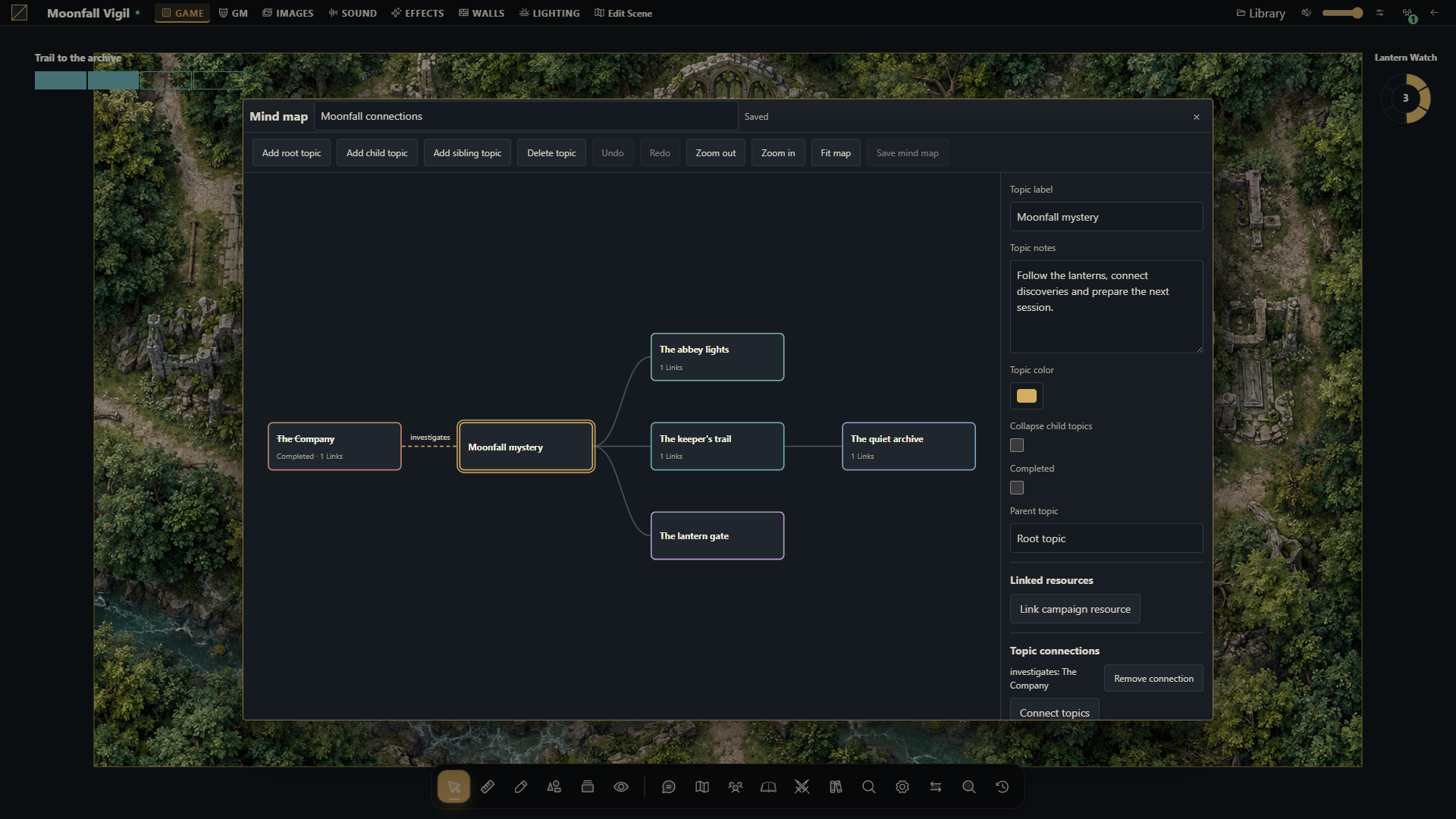
Create a graph
Open Mind maps in the lower table dock or campaign manager. A GM creates a named map, chooses campaign/scene scope and sets visibility and editors. New maps are GM-only. Add root, child or sibling topics, edit notes/color/completion, collapse branches and draw additional labeled connections. Drag topics to position them; drag empty canvas to pan, use zoom or Fit map.
Undo/redo affects the local draft. Save mind map sends the expected saved version. A conflict keeps the draft and offers explicit reload; it does not silently overwrite another editor. Closing modified work asks whether to discard it.
Grant the intended access
All campaign GMs edit maps. Visible to players grants reading, while selected player editors can also read and edit a private map from the table. Those editors may rename the map and edit topics, but cannot change scope, visibility, the editor list or delete the map. Streamers remain read-only. Scene-scoped maps additionally require access to their scene. The campaign manager itself remains GM-only.
Topic notes belong to the whole map's audience: keep private planning in a private map. A hidden link does not make the surrounding authored text private.
Link campaign resources
Use Link campaign resource to search the authorized catalog of 37 native types: characters and files, items, journals/pages/quests, scenes and objects, tokens, encounters, clocks, discovered clues, audio, cards, compendiums, preparation, authoring resources, visible chat messages and mind maps. The complete reference lists the types and availability rules.
Links keep typed identities and recheck access on opening. They neither copy documents nor grant permission. Missing and denied targets look equally unavailable, with no private identifier or title. Saving another topic preserves an existing unavailable link through an opaque placeholder; removing it deletes the connection.
Integrate and transfer
MapBuilder offers Open mind map and Control mind-map topic. Opening rechecks each recipient; completion controls delegate only the configured effect. Native rehearsal rolls back effects and receipts. Campaign copies select Mind maps, remap included typed resources, keep local topic IDs and authored text, and clear source player-editor grants. Snapshots restore the same campaign's grants.
A campaign supports 64 maps; a graph supports 500 topics, 1,000 additional connections, 16 links per topic and 2,048 links overall. See the API and graph limits before building an integration.